
In vivo phage display is a highly valuable technology in molecular biology and biotechnology, particularly for the selection of peptides, proteins, antibodies and antibody fragments with specific binding properties. By linking genetic information to a displayed molecule on the surface of a bacteriophage, this approach enables large libraries to be screened against defined targets and supports the identification of candidates with high affinity and relevant targeting properties.
Table of Contents
In vivo phage display extends this selection process into living organisms. This can be particularly useful when the objective is to identify candidates with defined biological properties, including tumour targeting, blood-brain barrier crossing capacity or organ-specific binding.
What is phage display?
Phage display was first introduced in the 1980s and is based on a direct link between a displayed molecule and the genetic sequence that encodes it. In practical terms, foreign DNA fragments are inserted into genes encoding phage coat proteins, allowing peptides, proteins or antibody fragments to be presented on the surface of bacteriophages.
This generates large phage libraries displaying diverse molecular variants. These libraries can then be screened through selection cycles designed to identify phages that bind to a target of interest. Bound phages are recovered, amplified and analysed, allowing researchers to enrich for candidates with the desired binding profile.
This principle has supported different areas of biomedical research, including therapeutic antibody development, biomarker identification and the study of protein–protein interactions.
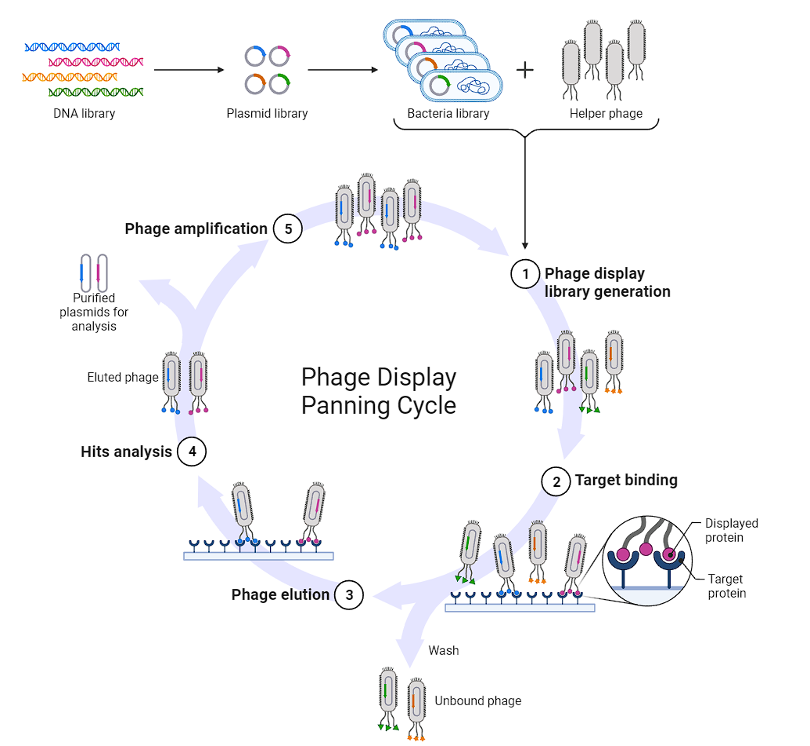
The conventional phage display panning cycle.
How in vivo phage display works
In vivo phage display follows the same selection logic, but the process takes place inside a living organism. Rather than screening the library only against an isolated target, the phage library is administered to an in vivo model, where displayed binders can interact with targets present in organs or tissues within a biological environment.
This is particularly relevant when the target is difficult to adequately represent in vitro, when its native conformation is important, or when the selection must consider properties such as tissue access, specificity and pharmacokinetic behaviour.
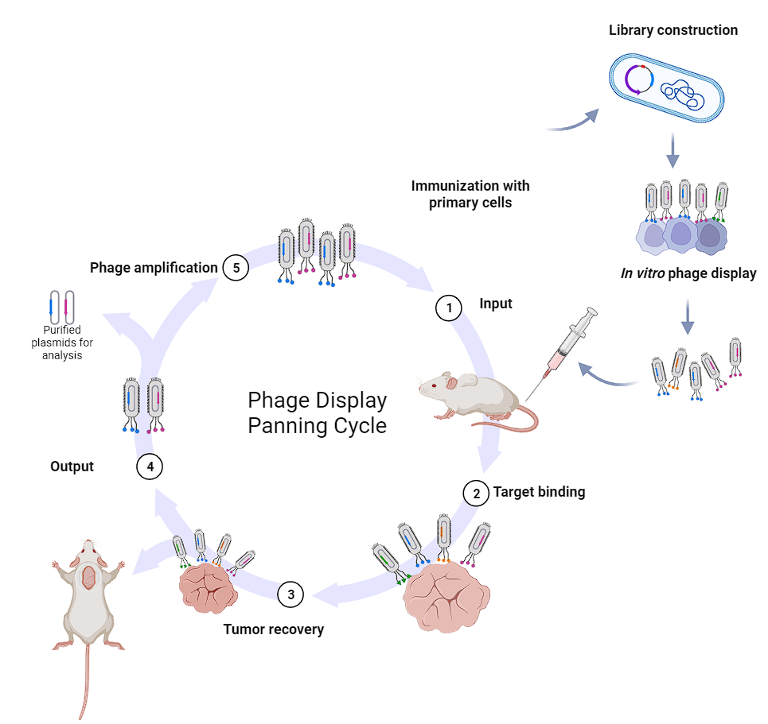
In vivo phage display panning cycle.
Selection using in vivo models
In a typical in vivo phage display experiment, the phage library is injected intravenously and allowed to circulate for a defined period. During circulation, the antibody fragments displayed on the phage surface may bind to specific targets present in organs or tissues.
After this step, perfusion is performed to remove unbound or non-specific phages. The organ or tissue of interest is then collected, allowing the recovery of phages associated with the intended biological site.
This workflow allows selection to occur in a complex in vivo context, where biodistribution, target availability in organs or tissues, phage stability and binding specificity influence which candidates are recovered.
Recovery, amplification and analysis of selected binders
Recovered phages can be titrated, re-amplified and used in further rounds of selection. This progressive enrichment supports the identification of binders with the desired properties.
Antibody libraries used in phage display
The type of antibody library used in a phage display campaign has a direct impact on the probability of identifying candidates with the intended characteristics. Immune, naïve and synthetic libraries each offer different advantages, depending on the target, the selection strategy and the desired molecular profile.
Immune libraries
Immune libraries are generated from donors previously exposed to a specific antigen. Since the antibody fragments have undergone an in vivo maturation process, these libraries can support the selection of high-affinity binders.
Their main limitation is the need for prior immunisation. This adds time, depends on the quality of the immune response and usually requires a new library for each antigen.
Naïve libraries
Naïve libraries are obtained from non-immunised donors and represent the natural diversity of the antibody repertoire. They allow antibody selection without previous exposure to the antigen, which can be useful for self-antigens, toxic antigens or poorly immunogenic targets.
However, their complexity can make the repertoire difficult to control. Some selected antibodies may also present expression challenges in bacterial systems.
Synthetic libraries
Synthetic libraries are created in vitro by introducing controlled diversity into specific antibody regions, particularly the complementarity-determining regions. This enables greater control over library design and can help address some limitations associated with natural repertoires, including expression constraints and uncontrolled variability.
Applications of in vivo phage display in drug discovery
In vivo phage display can support drug discovery when candidate selection depends on biological properties that are difficult to assess in vitro. These may include tissue access, target specificity, tumour tropism, blood-brain barrier crossing or organ-specific binding.
Antibody and peptide selection
By screening large libraries in a biological context, in vivo phage display can support the identification of antibodies, antibody fragments and peptides with specific binding characteristics. This is particularly relevant for complex targets, where native conformation, tissue localisation or disease-associated conditions may influence target recognition.
Tissue targeting, BBB crossing and drug delivery
In vivo phage display can be applied to the selection of binders with tissue-specific targeting properties. Relevant applications include tumour targeting, blood-brain barrier crossing and drug delivery strategies.
For neurological diseases, this approach can support the identification of candidates with blood-brain barrier crossing properties. In oncology, it can be used in disease-relevant models to select binders with tumour-targeting potential.
Key parameters and limitations in in vivo phage display
Several factors can influence the success of an in vivo phage display campaign:
- Phage survival: phage particles may be rapidly cleared from circulation, affecting recovery and enrichment;
- Biodistribution: accumulation in organs such as the liver and spleen can influence the outcome of selection;
- Circulation time: circulation time can strongly affect recovery and should be optimised for each model and phage type;
- Route of administration: intravenous administration is central to the described in vivo selection workflow;
- Target availability: the target must be available to circulating phages under the selected experimental conditions;
- Library diversity: bacterial transformation, phage packaging and secretion processes can limit library capacity;
- Expression constraints: not all sequences are efficiently displayed on phages, particularly when correct folding is required;
- Protocol optimisation: circulation time, recovery strategy and downstream analysis should be defined according to the intended biological output.
These parameters make study design decisive. For this reason, in vivo phage display requires careful alignment between the library, model, target, circulation conditions and recovery method.
Ethical considerations in in vivo phage display research
In vivo phage display must be considered within the ethical and regulatory principles that apply to in vivo research. European guidance encourages the use of non-animal methodologies whenever scientifically appropriate, and this principle should guide experimental planning from the outset.
Within this framework, in vivo phage display can support a more selective development strategy. By helping identify stronger lead candidates earlier, based on specificity, stability, pharmacokinetic behaviour and targeting properties, it may reduce the number of candidates that progress into later efficacy and safety studies.
VectorB2B and FASLAB’s in vivo phage display platform
FASLAB is a member of the VectorB2B association and has established experience in phage display technology. Its in-house in vivo phage display platform supports antibody selection in disease-relevant preclinical models, with particular focus on targeting and delivery-related properties.
The platform includes:
- Construction of phage display libraries;
- Optimised in vivo phage display selection protocols;
- Customised in vivo models;
- Enrichment screening through successive selection rounds;
- Next-generation sequencing of selected binders;
- Reference controls selected according to assay requirements;
- Identification of organ-specific moieties;
- Isolation and identification of targeting phage-displayed binders.
Potential applications include neurological diseases, such as Alzheimer’s disease, where blood-brain barrier crossing properties are relevant, as well as oncological diseases, including lymphoma, breast cancer and glioblastoma.
Explore VectorB2B’s in vivo phage display services to understand how targeted selection in disease-relevant models can support your antibody discovery programme, from library construction and in vivo selection to NGS analysis and binder identification. Contact our team to discuss the most suitable strategy for your project.
Frequently asked questions (FAQ)
1. At what stage of a drug development programme can in vivo phage display be useful?
In vivo phage display can be useful during early discovery and lead selection, particularly when a programme requires binders with tissue-specific, disease-relevant or delivery-related properties before broader preclinical evaluation.
2. How many selection rounds are typically required in an in vivo phage display campaign?
The number of rounds depends on the target, library and model. In established workflows, successive rounds of selection are used to enrich binders with the intended properties before downstream analysis.
3. What information is needed to design a customised in vivo phage display study?
A customised study requires clear information about the biological target, intended tissue or organ, binder format, in vivo model, administration route, circulation time, recovery method and downstream analysis strategy.
VectorB2B Articles
Insights and analysis across the life sciences ecosystem, from research and development to regulatory, operational and strategic frameworks.
Find something interesting?
Share it with your peers!
Article topics
Explore other articles