

Biotherapeutics have become essential across several demanding therapeutic areas, including oncology, chronic inflammatory diseases and rare enzyme deficiencies. Their clinical value depends on complex biological mechanisms, specific molecular interactions and adequate therapeutic exposure. For this reason, drug immunogenicity is a critical consideration throughout biotherapeutic development.
Table of Contents
When a patient develops an immune response against a therapeutic product, that response may remain clinically limited or it may affect how the product behaves in the body. Anti-drug antibodies (ADA) can influence pharmacokinetics, pharmacodynamics, efficacy, infusion reactions, hypersensitivity or other safety outcomes. Their clinical relevance depends on the characteristics of the antibody response, the therapeutic product and the treatment context.
A robust drug immunogenicity programme should therefore do more than detect ADA. It should help determine whether an immune response is biologically meaningful, clinically relevant and important for development decisions. This requires appropriate ADA assays, neutralising antibody assessment when justified, therapeutic drug monitoring and integrated interpretation of analytical, clinical and safety data.
Why drug immunogenicity matters in biotherapeutic development
Biological therapies can trigger immune responses against the therapeutic product. In biotherapeutic development, these responses may vary considerably between patients and products, ranging from transient, low-titre anti-drug antibody responses to persistent, high-titre or neutralising responses.
This variability makes drug immunogenicity an important analytical and clinical consideration. ADA detection should be interpreted in relation to the broader performance of the therapeutic product, including:
- Drug concentration;
- Pharmacokinetic and pharmacodynamic behaviour;
- Clinical efficacy;
- Infusion reactions and hypersensitivity;
- Other relevant safety outcomes.
For sponsors, the value of drug immunogenicity assessment lies in generating interpretable evidence. A structured programme connects ADA results with clinical and biological context, helping teams understand whether an immune response may affect the performance, safety profile or development pathway of a biotherapeutic.
What are ADA and neutralising antibody (NAb) responses?
Anti-drug antibodies are immune responses directed against a therapeutic product. In drug immunogenicity assessment, ADA are evaluated to understand whether a patient’s immune response may affect drug exposure, biological activity, efficacy or safety.
The relevance of ADA depends on the characteristics of the response. ADA may be transient or persistent, low or high titre, treatment-induced or treatment-boosted, non-neutralising or neutralising. This means that ADA incidence alone is not sufficient to explain biological or clinical significance.
Neutralising antibodies are a functionally relevant subset of ADA. Their assessment becomes particularly important when antibodies may interfere with the therapeutic mechanism of action or reduce the expected biological activity of the biotherapeutic.
A regulatory-aligned approach to ADA and NAb assessment
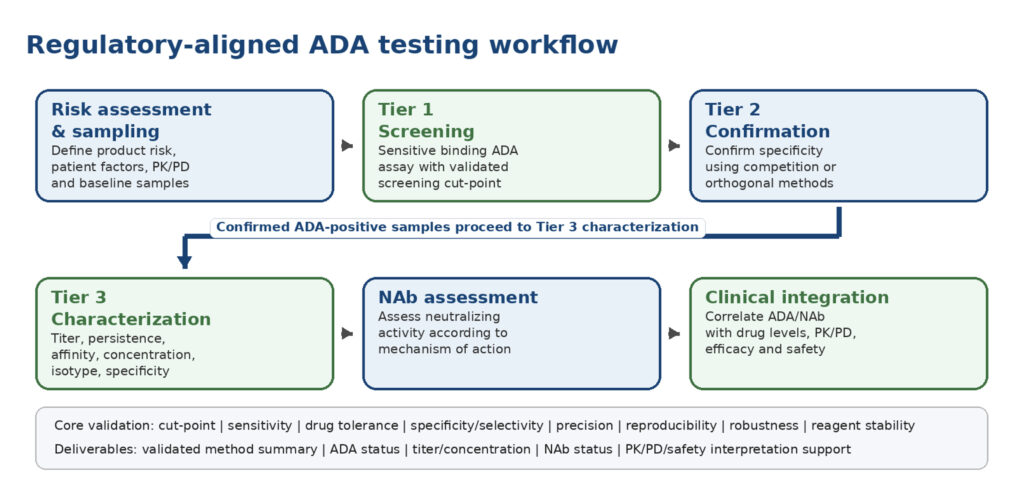
A structured drug immunogenicity programme should follow a tiered testing strategy, aligned with regulatory expectations for ADA and NAb assessment. This approach enables a logical progression from detection to confirmation, characterisation and functional evaluation when required.
The aim is to generate reliable immunogenicity data that can be interpreted in the context of the therapeutic product, the patient population and the clinical development programme.
ADA screening, confirmation and characterisation
ADA assessment typically begins with screening and confirmatory assays. These methods should be developed, optimised, qualified and validated according to the development stage, assay purpose and intended use.
Suitable formats may include ELISA, bridging assays, fibre-optic surface plasmon resonance (FO-SPR) or tailored ligand-binding approaches.
When clinically justified, enhanced ADA characterisation may include:
- Endpoint titre;
- Persistence or transience;
- Treatment-induced or treatment-boosted classification;
- Isotype or subclass;
- Domain specificity;
- Cross-reactivity.
This additional information can help clarify whether ADA responses are likely to be biologically meaningful or associated with changes in exposure, activity, efficacy or safety.
Neutralising antibody assays
Neutralising antibody assays assess whether ADA responses interfere with the biological activity of the biotherapeutic. Their design should reflect the therapeutic mechanism of action and the biological question being addressed. Depending on the product, NAb assessment may use cell-free AlphaLISA, competitive ligand-binding or cell-based approaches. The most appropriate format depends on the therapeutic target, mechanism of action, matrix requirements, sensitivity needs and clinical relevance of the expected response.

Why immunogenicity results require integrated interpretation
Drug immunogenicity results should be interpreted together with drug concentration, PK/PD, efficacy and safety endpoints. This integrated view helps clarify whether an immune response is biologically meaningful, clinically relevant or unlikely to affect treatment performance.
ADA incidence rarely explains the full impact of an immune response. A more informative assessment considers the timing, magnitude, persistence and functional relevance of ADA responses, as well as their relationship with drug exposure and clinical outcomes.
Drug monitoring and ADA-drug interference
Therapeutic drug monitoring supports ADA interpretation by measuring circulating drug levels. This is particularly relevant when antibody responses may be associated with reduced exposure, altered pharmacokinetics or loss of response.
Circulating drug can also interfere with ADA assays by affecting the ability of the method to detect anti-drug antibodies. For this reason, ADA-drug interference assessment, appropriate trough-sampling strategies and drug-tolerance improvement approaches can strengthen the reliability of immunogenicity testing.
Biophysical ADA profiling and integrated reporting
Biophysical ADA profiling can provide additional information when deeper characterisation is required. FO-SPR and in-solution approaches may support the assessment of polyclonal ADA concentration, affinity, binding kinetics and immune complex formation directly in clinical samples.
Integrated reporting brings together ADA, NAb, drug level and biophysical results with PK/PD, efficacy and safety endpoints. This supports clearer interpretation of immunogenicity results and helps sponsors prepare more coherent clinical and regulatory documentation.
How VectorB2B supports drug immunogenicity assessment
Our Drug Immunogenicity Services support biopharmaceutical development from method development and validation to clinical sample testing and interpretation support.
Our portfolio includes:
- ADA screening and confirmatory assays;
- Therapeutic drug monitoring;
- ADA-drug interference assessment;
- Enhanced ADA characterisation;
- Biophysical ADA profiling;
- Neutralising antibody assays;
- Fit-for-purpose immunogenicity assays;
- Integrated immunogenicity reporting.
Our team also supports ADA and drug monitoring for approved enzyme replacement therapies in lysosomal storage disorders, including product-specific assay strategies and interpretation support.
By combining ADA, NAb, drug level and biophysical profiling, VectorB2B helps sponsors generate immunogenicity data that are scientifically robust, clinically interpretable and suitable for development and regulatory documentation.
Explore VectorB2B’s Drug Immunogenicity Services to understand how integrated immunogenicity assessment can support your biotherapeutic development programme. Contact our team to discuss your project requirements.
Frequently asked questions (FAQ)
1. What is the difference between ADA and NAb?
ADA are antibodies directed against a therapeutic product. NAb are a subset of ADA that may interfere with the biological activity or mechanism of action of the biotherapeutic.
2. Why can circulating drug interfere with ADA assessment?
Circulating drug may affect the ability of an assay to detect anti-drug antibodies. This is why drug monitoring, trough-sampling strategies and drug-tolerance approaches can be relevant in immunogenicity testing.
3. What should an immunogenicity report include?
An immunogenicity report should integrate ADA, NAb, drug level and, when appropriate, biophysical results with PK/PD, efficacy and safety endpoints. This supports a clearer interpretation of the immune response.
VectorB2B Articles
Insights and analysis across the life sciences ecosystem, from research and development to regulatory, operational and strategic frameworks.
Find something interesting?
Share it with your peers!
Article topics
Explore other articles