
Recombinant protein purification begins after a protein of interest has been produced by introducing and expressing its gene in a host organism. Expression alone, however, does not show whether that protein is functional or biologically relevant. The quality of the purified preparation matters across biopharmaceutical applications, structural biology, diagnostic platforms and therapeutic development.
Table of Contents
Purification must therefore separate the target protein from a complex biological mixture while preserving its activity and stability. Chromatography provides the selectivity required for this process. Automated platforms such as ÄKTA™ systems also allow critical parameters to be controlled precisely and monitored in real time throughout purification.
What does a recombinant protein purification workflow involve?
Each recombinant protein requires a purification strategy suited to its properties. At every stage, recovery yield must be balanced against the preservation of biological activity. Charge, size, oligomeric behaviour and solubility all influence the design of the process, together with the sensitivity of the downstream assay or therapeutic pipeline.
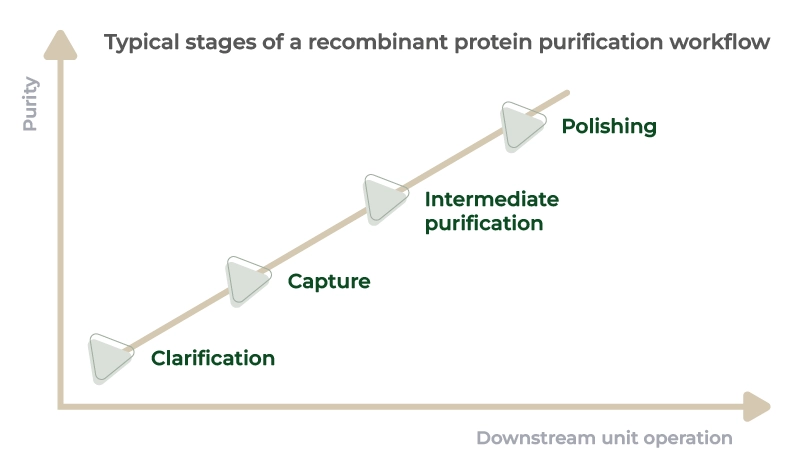
The workflow starts with upstream expression and primary recovery. Selective capture is followed by intermediate purification and final polishing, after which the purified protein undergoes quality control and formulation for storage.
Sample preparation and selective capture
After cell disruption, the crude lysate contains host cell proteins, genomic DNA, lipids and particulate debris. Clarification through high-speed centrifugation and depth or membrane filtration removes insoluble particles that could obstruct column frits and cause critical increases in backpressure.
This step also helps prevent resin fouling, preserve dynamic binding capacity and improve reproducibility across production batches.
Affinity chromatography is commonly used for selective capture. For proteins containing affinity tags, one widely applied method is immobilised metal affinity chromatography (IMAC), which uses the interaction between histidine residues and immobilised metal ions. Its performance depends on the optimisation of:
- Binding conditions;
- Imidazole concentration;
- Ionic strength;
- pH.
These parameters influence target protein recovery and contaminant co-elution.
Intermediate purification and final polishing
Affinity chromatography may leave contaminants, aggregates, truncated products or oligomeric species in the sample during recombinant protein purification. Further purification can therefore involve:
- Intermediate purification: ion exchange chromatography separates proteins according to surface charge, while hydrophobic interaction chromatography separates them according to differences in exposed hydrophobic regions under high-salt conditions;
- Final polishing: size exclusion chromatography (SEC), also known as gel filtration chromatography, separates aggregates, oligomers and monomeric proteins according to their hydrodynamic size.
By separating proteins according to hydrodynamic size without relying on binding interactions, SEC is particularly well suited to final polishing under native conditions, helping preserve protein structure while enabling the quality of the purified preparation to be evaluated.
How do ÄKTA systems improve protein purification?
ÄKTA™ chromatography systems bring automation, process control, real-time monitoring and reproducibility into the same protein purification platform. During each run, the system controls flow rates and gradient formation while monitoring pressure, reducing the variability associated with manual operation.
UV absorbance, conductivity, pH and system backpressure are monitored continuously. These data offer immediate insight into target protein elution kinetics and chromatographic peak profiles, as well as column packing integrity and potential precipitation events.
This controlled environment supports the development of standardised recombinant protein purification methods for different targets and applications. It also facilitates the scalability of purification workflows from bench-scale work to production applications.

How is protein quality assessed and preserved?
Once purification is complete, analytical characterisation is used to confirm the protein’s identity, purity, concentration and stability. Common techniques include:
- SDS-PAGE, which evaluates sample purity and estimates molecular weight under reducing or non-reducing conditions;
- Western blotting, which confirms protein identity using specific antibodies;
- UV absorbance and protein quantification assays, which determine concentration and support the calculation of total yield and recovery efficiency;
- Analytical SEC, which assesses homogeneity, oligomeric state and the presence of aggregates.
Together, these methods provide a comprehensive assessment of protein quality before functional assays or other downstream applications.
After recombinant protein purification, storage conditions need to reflect the properties of the target protein. Buffer composition, pH, ionic strength, temperature, protein concentration and freeze–thaw cycles can all affect stability. Establishing customised conditions helps preserve structural integrity, solubility and biological activity while accommodating the technical requirements of subsequent processes.
Recombinant protein purification at VectorB2B
VectorB2B uses automated ÄKTA™ chromatography systems to develop customised purification workflows for a wide range of recombinant proteins, adapting each process to the biochemical properties of the target protein.
We have particular expertise in purifying recombinant antibody fragments, including single-domain antibodies (sdAbs), through workflows that combine affinity chromatography with appropriate polishing techniques. Contact us to discuss the recombinant protein purification requirements of your project.
Frequently asked questions (FAQ)
1. How can automation improve reproducibility across purification batches?
Automated chromatography systems apply defined conditions throughout successive purification runs. Consistent control of flow rates and gradient formation reduces operator-dependent variability, while continuous pressure monitoring provides further visibility into each run.
2. Can the same purification workflow be used for different recombinant proteins?
Each recombinant protein requires a workflow adapted to its biochemical properties. Charge, size, oligomeric behaviour and solubility influence the design of the purification process, together with the sensitivity of the downstream assay or therapeutic pipeline.
3. What supports the scalability of recombinant protein purification from bench-scale work to production applications?
Standardised purification methods can support the transition from bench-scale work to production applications. By controlling flow rates and gradient formation consistently while monitoring pressure, ÄKTA™ systems can support the scalability of recombinant protein purification workflows.
VectorB2B Articles
Insights and analysis across the life sciences ecosystem, from research and development to regulatory, operational and strategic frameworks.
Find something interesting?
Share it with your peers!
Article topics
Explore other articles